
The art of staying.
AERA
Continuity Protected Through Hospitality
AERA is a Governed Hospitality System structured around the Condition of Life of Continuity.
It is designed for people whose professional, personal and family lives unfold across multiple territories and who need to continue living naturally while temporarily inhabiting another place.
Conventional hospitality is generally organised around arrival, temporary occupation and departure.
AERA follows a different logic.
It creates long-duration hospitality environments in which living, working, privacy and everyday routines can continue without being organised around the conventional rhythms of a hotel or resort.
Inhabitants do not suspend their lives when they arrive.
They continue them.
THE CONDITION OF CONTINUITY
Contemporary life increasingly extends across different cities, countries, professional responsibilities and family structures.
Yet most hospitality environments remain designed for temporary stays.
Daily life is organised around hotel schedules, programmed services and short-term occupation.
AERA provides a different foundation.
It combines the autonomy of private living with the coherence, service and institutional continuity of hospitality.
The objective is not to reproduce a permanent residence.
It is to enable people to inhabit another territory without interrupting the essential structure of their lives.
THE AERA ENVIRONMENT
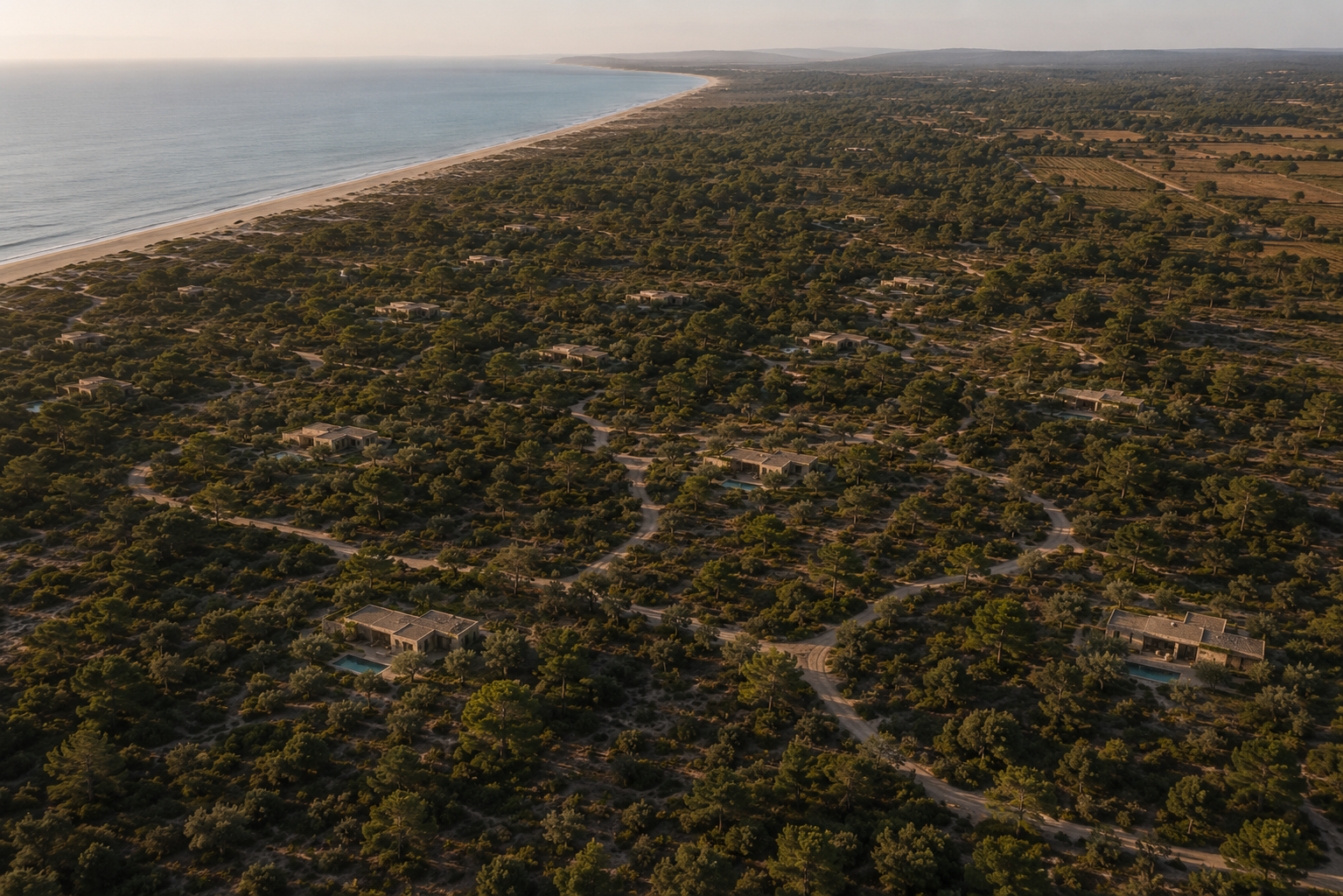
AERA environments are private, low-density and designed for long-duration inhabitation.
They provide:
→ Autonomous private living environments.
→ Privacy without complete isolation.
→ Discreet and responsive hospitality services.
→ Architecture integrated into the territory.
→ A natural relationship between indoor and outdoor living.
→ Freedom from compulsory programming.
→ Continuity of personal, family and professional routines.
Hospitality remains present.
It does not dominate everyday life.
The inhabitant determines the rhythm of the stay.
THREE TERRITORIAL TYPOLOGIES
AERA is not defined by countries or predetermined destinations.
It is defined by territorial compatibility.
This compatibility is governed by Calm Proximity: the simultaneous preservation of connection to an active centre and sufficient spatial and behavioural detachment from it.
The system may be expressed through three principal territorial typologies.
PERI-URBAN
Low-density environments located within practical reach of an active metropolitan centre.
AERA Peri-Urban combines accessibility with behavioural and spatial separation from the continuous density of the city.
The city remains accessible.
The hospitality environment protects continuity.
COASTAL TRANSITION
Low-density coastal environments shaped by openness, light, climate and spatial detachment from surrounding intensity.
AERA Coastal does not follow conventional resort or beach-club logic.
The coast supports everyday inhabitation rather than a programmed holiday experience.
QUIET INLAND
Quiet inland territories defined by privacy, spatial permanence and long-duration inhabitation.
AERA Inland provides meaningful separation from urban intensity without becoming an isolated retreat or a productive-landscape hospitality model.
The territory supports continuity through space, privacy and environmental stability.
TWO AERA DEVELOPMENT EXPRESSIONS
AERA may be developed through two distinct hospitality expressions.
Both are governed by the same Condition of Life of Continuity, the same institutional doctrine and the same principles of autonomous inhabitation, privacy, discreet hospitality and Calm Proximity.
They are not interchangeable typologies and they are not combined into a hybrid product.
AERA PREMIUM VILLAS
AERA Premium Villas is the original low-density expression of the system.
It is composed of individually separated private villas positioned within generous territorial environments where landscape, distance and privacy form an integral part of the inhabited condition.
Premium Villas may be developed within the three principal AERA territorial typologies:
→ Peri-Urban.
→ Coastal Transition.
→ Quiet Inland.
The model prioritises substantial private territory, architectural independence between units and a particularly high degree of spatial separation.
AERA TERRACED VILLAS
AERA Terraced Villas provides a more compact expression of Continuity while preserving the essential autonomy and privacy required by AERA.
Each hospitality villa remains individually inhabited and provides a complete domestic environment, dedicated working capacity, private exterior space and its own entrance.
Terraced Villas are organised through carefully composed low-rise, single-storey architectural groups rather than conventional apartment buildings or hotel accommodation.
AERA Terraced Villas is applicable to:
→ Peri-Urban environments.
→ Coastal Transition environments.
It is not applied to the Quiet Inland typology, whose territorial logic remains associated with the greater spatial separation of AERA Premium Villas.
ADJACENT DEVELOPMENT
AERA Premium Villas and AERA Terraced Villas may be developed independently or as two adjacent AERA projects within the same broader territory.
Where they are developed next to one another, each remains a distinct development expression with its own spatial standards, density, programme and economic model.
They are coordinated through the same AERA doctrine but are never merged into an intermediate or hybrid typology.
DESIGNED FOR CONTINUITY
AERA is designed for people seeking continuity rather than temporary escape.
Entrepreneurs.
Families.
Executives.
Investors.
Independent professionals.
Individuals whose lives extend across multiple territories.
The common requirement is not a particular demographic profile.
It is the need to continue living coherently while away from one’s primary residence.
WHY AERA?
AERA occupies the space between conventional hospitality and residential living.
It combines:
→ Long-duration hospitality.
→ Autonomous inhabitation.
→ Private living environments.
→ Discreet hospitality services.
→ Low-density territorial planning.
→ Carefully integrated branded residences.
→ Architectural and climatic coherence.
→ Operator compatibility.
→ Long-term institutional continuity.
AERA BRANDED RESIDENCES
Where permitted by the applicable development configuration, an AERA environment may incorporate a carefully limited branded residential component.
AERA Branded Residences are not conceived as a separate real estate product placed alongside the hospitality environment.
They form part of the same territorial and institutional architecture.
They follow the same:
→ Architectural doctrine.
→ Territorial discipline.
→ Material and interior principles.
→ Privacy standards.
→ Service environment.
→ Long-term coherence requirements.
The residential component must not create a separate compound, introduce a competing identity or transform AERA into a predominantly residential development.
Hospitality remains the primary function of the environment.
When appropriately integrated, branded residences can support the project’s capital structure, broaden its long-term ownership proposition and reinforce asset value without weakening the Condition of Life of Continuity.
Detailed residential eligibility criteria, integration requirements and the applicable maximum participation threshold are defined within the AERA institutional frameworks and made available under NDA.
A DIFFERENT FORM OF VALUE
AERA creates value through continuity.
Continuity of life.
Continuity of routine.
Continuity of privacy.
Continuity across territories.
As professional, personal and family lives increasingly extend across different geographies, environments capable of supporting long-duration continuity become increasingly relevant.
Projects may differ.
Territories may differ.
Architectural expressions may differ.
Operators may differ.
The governing Condition of Life remains the same.
Continuity.