
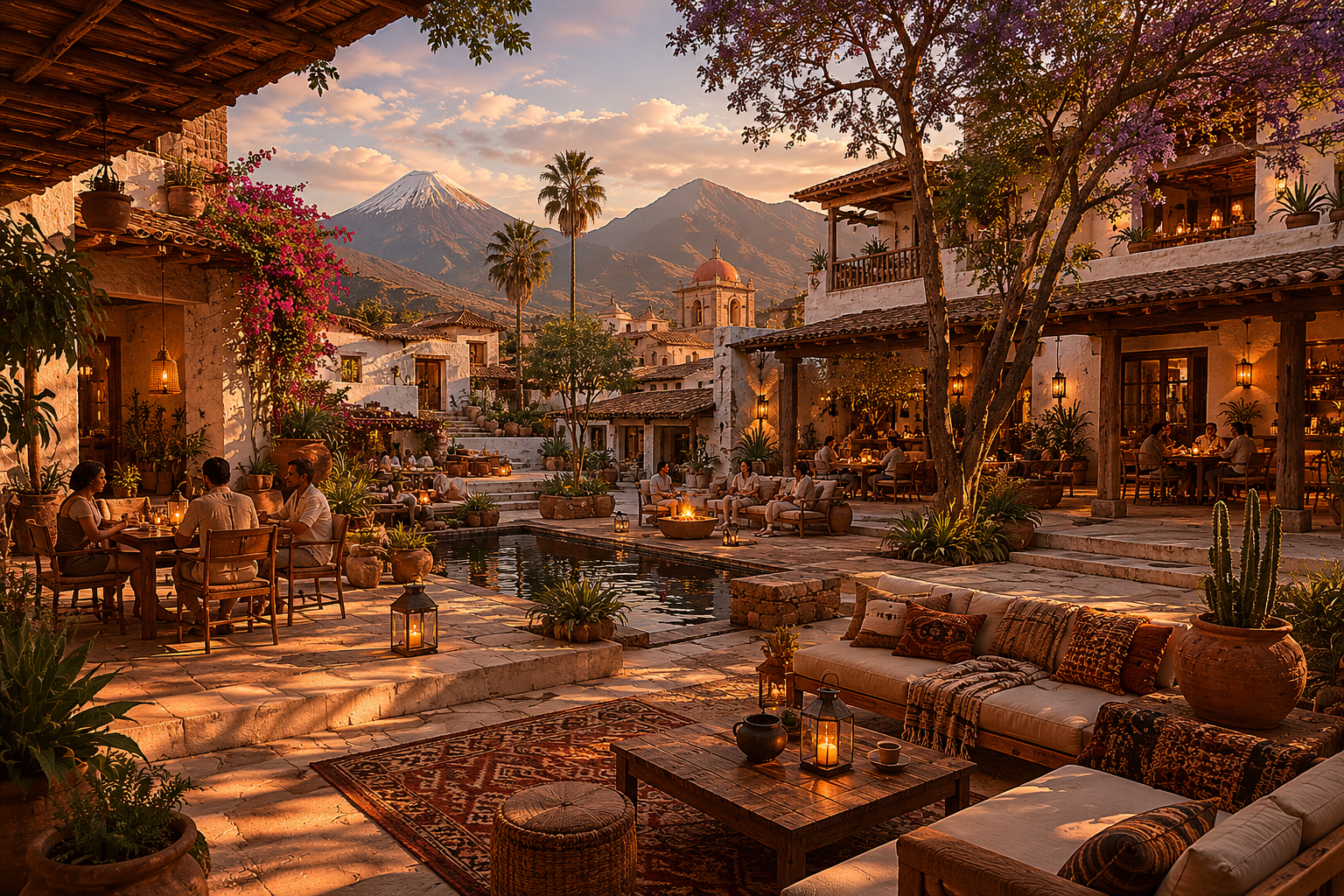
Places across Latin America.
AYLLU
ENGAGEMENT PROTECTED THROUGH CONTEMPORARY LATIN AMERICAN HOSPITALITY
AYLLU is a Governed Hospitality System structured around the Condition of Life of Engagement.
It creates contemporary hospitality environments that emerge from Latin American territories rather than being imposed upon them.
Architecture follows climate.
Hospitality follows territory.
Every project is shaped by its landscape, city, culture, materials, public life and way of living.
AYLLU does not seek to standardise hospitality across Latin America.
It provides the institutional architecture through which each project can express the identity of its own territory while remaining part of one coherent hospitality system.
Projects may differ.
Territories may differ.
Cultures may differ.
Architectural expressions may differ.
The governing Condition of Life remains constant.
Engagement.
THE CONDITION OF ENGAGEMENT
Engagement is an active relationship with a place.
Its climate.
Its architecture.
Its food.
Its culture.
Its public life.
Its landscape.
Its people.
Its contemporary reality.
Many hospitality environments separate guests from the territory surrounding them.
Local identity becomes decoration.
Culture becomes programming.
Architecture becomes transferable.
The project could exist almost anywhere.
AYLLU follows a different logic.
The territory, climate and living culture become the foundations from which the hospitality environment is defined.
Guests do not observe the territory from an isolated hospitality environment.
They engage with its contemporary life.
LATIN AMERICA IS NOT A STYLE
AYLLU does not define a single Latin American aesthetic.
Latin America is not one architectural language, one material palette or one cultural expression.
A project in Mexico City should not resemble one in Buenos Aires.
A project in Cartagena should not resemble one in Santiago.
A coastal project in Brazil should not resemble a landscape project in Patagonia or a Winelands project in Argentina.
The climate changes.
The architecture changes.
The materials change.
The food changes.
The social rhythm changes.
The atmosphere changes.
AYLLU creates coherence through institutional principles, not visual repetition.
The system remains recognisable through its relationship with territory, climate, architecture and contemporary Latin American life.
THE AYLLU ENVIRONMENT
An AYLLU environment is shaped from within its territory.
It may combine:
→ Climate-responsive contemporary Latin American architecture.
→ Territorial materials and construction intelligence.
→ Restaurants and gastronomy connected to the place.
→ Courtyards, patios, terraces, gardens and public environments.
→ Active relationships with streets, neighbourhoods and surrounding life.
→ Contemporary Latin American creativity and material culture.
→ Hospitality services aligned with local patterns of use.
→ Carefully integrated branded residences where permitted.
The project does not use Latin American identity as a decorative theme.
Its identity emerges through the relationship between architecture, climate, territory and living culture.
SEVEN HOSPITALITY TYPOLOGIES
AYLLU is applied through seven autonomous hospitality typologies.
Each responds to a different territorial and development context while remaining governed by the same Condition of Life of Engagement and the institutional principles of AYLLU.
URBAN
Contemporary hospitality integrated into Latin American cities, neighbourhoods, business districts and everyday urban life.
Urban projects engage with the street, public life, gastronomy, commerce and the social rhythm of the city.
Architecture responds to density, climate, movement and the specific identity of the surrounding urban territory.
Branded residences may be incorporated where permitted by the applicable AYLLU Urban framework and within its defined participation threshold.
COASTAL
Low-density hospitality shaped by climate, vegetation, coastline and maritime culture.
Architecture responds to light, wind, shade, water and the relationship between interior and exterior life.
The coastline is not treated as scenery alone.
It actively determines the identity, atmosphere and spatial logic of the project.
Branded residences may be incorporated where permitted by the applicable AYLLU Coastal framework and within its defined participation threshold.
LANDSCAPE
Hospitality integrated into mountains, countryside, gardens and significant natural territorial environments.
Architecture remains subordinate to topography, vegetation, climate and landscape scale.
The project inhabits the territory without visually dominating it.
Branded residences may be incorporated where permitted by the applicable AYLLU Landscape framework and within its defined participation threshold.
HERITAGE
Architecturally significant historic buildings reactivated through adaptive reuse and contemporary hospitality.
The building’s memory, materials and urban identity remain visible without becoming nostalgic or decorative.
Heritage is inhabited rather than staged.
Branded residences may be incorporated where permitted by the applicable AYLLU Heritage framework and within its defined participation threshold.
GUESTHOUSE
Small-scale hospitality defined by strong architectural identity, gastronomy, intimacy and neighbourhood integration.
The Guesthouse typology creates a direct relationship between guests, hosts and surrounding local life.
Its value emerges through scale, specificity and personal atmosphere.
Branded residences may be incorporated where permitted by the applicable AYLLU Guesthouse framework and within its defined participation threshold.
MIXED-USE
Hospitality integrated with residences, retail, gastronomy, culture, workspaces and public life.
Mixed-Use projects create active environments in which hospitality contributes to the identity and vitality of a wider urban or territorial development.
Branded residences may be incorporated where permitted by the applicable AYLLU Mixed-Use framework and within its defined participation threshold.
WINELANDS
Hospitality rooted in Latin American wine regions, gastronomy, craftsmanship and the cultural identity of cultivated landscapes.
Architecture, food, materials and hospitality emerge from the specific character of the wine territory.
The landscape remains active and territorially meaningful.
Branded residences may be incorporated where permitted by the applicable AYLLU Winelands framework and within its defined participation threshold.
TERRITORIAL APPLICATION
AYLLU is not defined by a fixed list of countries or destinations.
It is defined by territorial compatibility within Latin America.
The system may be expressed through:
→ Cities.
→ Urban neighbourhoods.
→ Coastal territories.
→ Landscape environments.
→ Historic districts and buildings.
→ Residential neighbourhoods.
→ Mixed-use developments.
→ Latin American wine regions.
Each participating project is considered according to its climate, culture, territorial context, intended typology, development model and capacity to support a coherent contemporary Latin American hospitality environment.
AYLLU does not impose a predetermined hospitality identity upon a territory.
The identity of each project emerges from the territory in which it is developed.
DESIGNED FOR ENGAGEMENT
AYLLU may be relevant to:
→ Hospitality investors.
→ Developers.
→ Landowners.
→ Project owners.
→ Operators.
→ Public institutions.
→ Hospitality entrepreneurs.
→ Mixed-use development platforms.
The common objective is not simply to develop another hospitality asset in Latin America.
It is to create an environment capable of participating meaningfully in contemporary Latin American life while establishing a distinctive and durable hospitality position.
WHY AYLLU?
AYLLU enables internationally investable and operationally compatible hospitality projects to emerge from contemporary Latin American territorial identity.
It combines:
→ Climate-responsive architecture.
→ Strong territorial identity.
→ Contemporary Latin American hospitality.
→ Seven hospitality typologies.
→ Gastronomy and public life.
→ Branded residences where appropriate.
→ Operator compatibility.
→ Long-term territorial coherence.
→ Institutional development discipline.
AYLLU avoids two common approaches.
The first is to import a generic international hospitality model and add local references after the project has already been defined.
The second is to reduce Latin American identity to folklore, nostalgia or decorative imagery.
AYLLU follows neither.
It provides the institutional architecture through which a project can emerge from its own Latin American territory while remaining contemporary, investable, operationally credible and coherent over time.
AYLLU BRANDED RESIDENCES
Branded residences may be incorporated within any authorised AYLLU typology where permitted by its applicable development configuration and within the participation threshold defined for that typology.
AYLLU Branded Residences are not conceived as a separate real estate product placed beside the hospitality environment.
They form part of the same territorial and institutional architecture.
They follow the same:
→ Architectural doctrine.
→ Climate-responsive principles.
→ Territorial identity.
→ Interior and material standards.
→ Service environment.
→ Long-term coherence requirements.
Within an Urban project, residences remain integrated into the architectural and social life of the building or development.
Within a Coastal project, residences must remain subordinate to the territorial, climatic and hospitality identity of the environment.
Within a Landscape project, residences must remain dispersed and subordinate to the topography, vegetation and territorial scale of the hospitality environment.
Within a Heritage project, residences must remain integrated within the architectural logic, material identity and adaptive-reuse discipline of the existing asset.
Within a Guesthouse project, any residential component must remain strictly limited, integrated into the same architectural environment and proportionate to the small-scale hospitality character of the typology.
Within a Mixed-Use project, residences may form part of a wider programme connecting hospitality, living, commerce, culture and public life.
Within a Winelands project, residences must remain integrated into the cultivated landscape, architectural logic and territorial identity of the wine region.
Residential components may not create separate compounds, introduce competing architectural identities or weaken the relationship between the hospitality environment and its territory.
Hospitality remains structurally and quantitatively primary within every AYLLU typology.
When appropriately integrated, branded residences can support the project’s capital structure, broaden its ownership proposition and reinforce long-term asset value without fragmenting the identity of the development.
Detailed residential eligibility criteria, typology-specific integration requirements and the applicable maximum participation threshold for each typology are defined within the AYLLU institutional frameworks and made available under NDA.
WHAT MAKES AYLLU DIFFERENT?
Many hospitality projects in Latin America begin with an international model and introduce local identity later.
AYLLU begins with the Latin American territory.
Many projects use culture as visual language or programmed entertainment.
AYLLU treats living culture as part of the project’s architectural, gastronomic and social foundation.
Many hospitality models reproduce the same identity across different markets.
AYLLU allows each territory to generate a different expression.
The territory informs the identity.
The climate informs the architecture.
The culture informs the atmosphere.
Hospitality connects them.
Engagement emerges from their alignment.
A DIFFERENT FORM OF VALUE
AYLLU creates value through territorial identity.
Climate-responsive architecture.
Cultural relevance.
Contemporary Latin American positioning.
Gastronomy and public life.
Connection to surrounding territory.
Long-term coherence.
As hospitality becomes increasingly standardised, projects capable of expressing a credible and contemporary relationship with their Latin American territories become increasingly distinctive and valuable.
A project should not merely occupy a Latin American location.
It should emerge from it.
Projects may differ.
Territories may differ.
Typologies may differ.
Operators may differ.
The governing Condition of Life remains the same.
Engagement.