
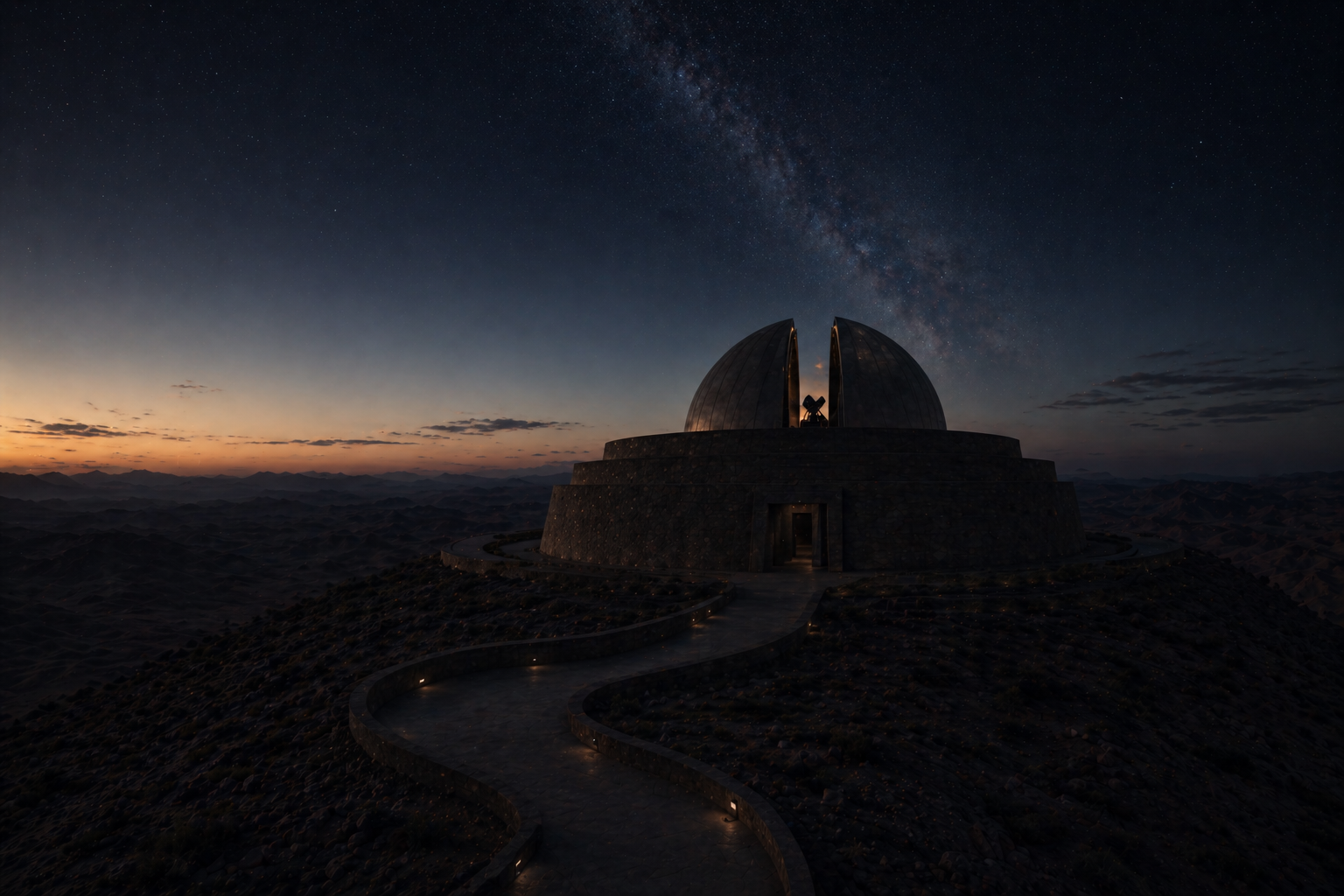
Rebirth in the Vastness of Infinity
NAARA
Withdrawal Protected Through Territory
NAARA is a Governed Hospitality System structured around the Condition of Life of Withdrawal.
It exists to preserve increasingly rare environmental conditions through which genuine withdrawal becomes possible.
Its institutional architecture embeds the doctrine, governance, validation, territorial discipline and protected parameters through which every participating project can remain recognisably NAARA over time.
NAARA operates as a finite global constellation of six ultra-low-density territories positioned within some of the world’s rarest environmental landscapes.
Each territory is selected according to its capacity to preserve five increasingly rare protected conditions:
Silence.
Darkness.
Vastness.
Distance.
Time.
These conditions constitute the primary territorial assets of every NAARA territory.
Architecture follows these conditions.
Hospitality follows these conditions.
Every project begins with these conditions.
WHAT IS A NAARA TERRITORY?
A NAARA Territory is an ultra-low-density hospitality environment occupying approximately 260 hectares within a rare environmental landscape.
Each territory is structured as two spatially independent Villa Constellations.
Each Villa Constellation comprises twelve Independent Villa Territories.
Each Independent Villa Territory provides approximately ten hectares of private territorial space for one villa.
The two Villa Constellations remain spatially independent and are organised around a discreet shared territorial structure comprising a private library and one monumental observatory.
These elements support the territory without creating a conventional hospitality centre or diminishing the spatial independence of either constellation.
Each territory therefore comprises:
→ Approximately 260 hectares.
→ Two spatially independent Villa Constellations.
→ Twelve villas per constellation.
→ Twenty-four villas in total.
→ Approximately ten hectares of territory per villa.
→ One private library.
→ One monumental observatory.
The territory remains primary.
Distance remains perceptible.
Silence remains intact.
Darkness remains intact.
Vastness remains intact.
Hospitality deliberately occupies only a minimal footprint within the territory.
The environmental condition remains the primary asset.
Different territories may produce radically different architectural expressions.
Different climates may require different material and spatial responses.
The institutional principles remain unchanged.
THE FIVE PROTECTED CONDITIONS
SILENCE
Silence is treated as a territorial condition.
It emerges through distance, environmental quiet, controlled access and the absence of unnecessary human or mechanical disturbance.
Silence creates a slower relationship with time.
A slower rhythm of life.
A different perception of space.
It allows Withdrawal to become physical, emotional and perceptual.
DARKNESS
Darkness is protected as environmental integrity.
Night skies remain visible.
Artificial light remains controlled.
Moonlight, shadow, celestial movement and astronomical scale remain perceptible within the territory.
The landscape remains connected to the natural cycles of day and night.
Darkness is not the absence of hospitality.
It is one of the rarest conditions that NAARA exists to preserve.
VASTNESS
Vastness is protected through territorial scale.
Extended horizons.
Large spatial breathing room.
Significant distance between structures.
Minimal human imprint across the environment.
Architecture occupies the territory without visually consuming it.
Vastness restores human proportion by positioning individual presence within a much larger environmental scale.
DISTANCE
Distance is protected as a condition in its own right.
It is created through the deliberate separation of villas, constellations, exposed spaces, enclosed spaces and human presence.
Each inhabitant must be able to experience the absence of the nearest other person, rather than merely visual privacy from another structure.
Distance allows the territory to remain perceptible between every element of inhabitation.
It is not isolation produced by enclosure.
It is separation made possible by territorial scale.
TIME
Time is protected by removing the pressures, programming and visible operational rhythms that ordinarily structure a hospitality stay.
NAARA does not prescribe activities, schedules or outcomes.
Service remains imperceptible, movement remains unhurried and the territory is allowed to determine the rhythm of inhabitation.
Time is not treated as an itinerary to be filled.
It becomes a condition that can once again be perceived.
THE GLOBAL CONSTELLATION
PRIMARY TERRITORIES
The following territories constitute the six primary territorial positions identified within the NAARA global constellation:
→ Utah.
→ Montana.
→ New Mexico.
→ Namib.
→ Atacama.
→ Empty Quarter.
Six territories.
Approximately 260 hectares per territory.
Two Villa Constellations per territory.
Twelve Independent Villa Territories per constellation.
Twenty-four villas per territory.
One hundred and forty-four villas globally.
One finite global constellation.
STRATEGIC RESERVE TERRITORIES
→ Mongolia.
→ Outback.
→ Patagonia.
Strategic Reserve Territories do not increase the constitutional limit of six active NAARA territories.
They preserve territorial optionality should a primary territory become unavailable, incompatible or impossible to activate.
A Strategic Reserve Territory may replace a primary territory.
It may not be added as a seventh territory.
The global limit remains unchanged:
Six territories.
One hundred and forty-four villas.
One finite global constellation.
WHY NAARA?
Conventional luxury hospitality often creates exclusivity primarily through service, privacy and controlled access.
NAARA creates rarity through environmental conditions.
Conventional hospitality development often increases density to maximise commercial performance.
NAARA protects long-term value through finite deployment, ultra-low density and territorial discipline.
Conventional hospitality often places the built project at the centre.
NAARA places the territory first.
Architecture does not attempt to compete with the landscape or become the territory’s primary object.
It allows the territory to be inhabited without ceasing to remain vast, silent, dark and distant.
The environmental condition becomes the primary asset.
THREE SIMULTANEOUS SCALES
HUMAN SCALE
Silence.
Distance.
Uninterrupted Time.
Freedom from continuous exposure and social demand.
The individual regains distance from density, noise, continuous exposure and social demand.
LANDSCAPE SCALE
Topography.
Horizon.
Environmental continuity.
Territorial distance.
Minimal architectural occupation.
The project remains subordinate to the scale and integrity of the landscape.
COSMIC SCALE
Night-sky visibility.
Celestial orientation.
Astronomical perception.
Natural cycles of light and darkness.
Human presence is repositioned within an environmental scale larger than the project itself.
FINITE BY DESIGN
NAARA operates through a finite territorial framework.
Six territories worldwide.
Approximately 260 hectares per territory.
Two Villa Constellations within each territory.
Twelve Independent Villa Territories within each constellation.
Twenty-four villas per territory.
One hundred and forty-four villas globally.
No seventh territory.
No increase beyond the global villa limit.
Controlled rarity forms part of NAARA’s protected institutional architecture.
The system does not create value through unlimited expansion.
Its value increases through the successful activation, long-term protection and environmental integrity of its six territories.
The global constellation remains finite by design.
A DIFFERENT FORM OF VALUE
NAARA creates value through the rarity of the five conditions it protects.
Silence.
Darkness.
Vastness.
Distance.
Time.
As these conditions become increasingly difficult to find and preserve, territories capable of protecting them become increasingly significant.
Value emerges through:
→ Territorial rarity.
→ Environmental integrity.
→ Ultra-low density.
→ Perceptible distance between human presences.
→ Protection of darkness and the natural night.
→ Freedom from imposed programming and compressed time.
→ Finite global deployment.
→ Long-term institutional coherence.
→ The preservation of conditions that cannot be manufactured or replicated.
The objective is not to increase hospitality presence within rare territories.
It is to inhabit them with sufficient restraint to preserve Silence, Darkness, Vastness, Distance and Time, the five conditions through which genuine Withdrawal remains possible.