
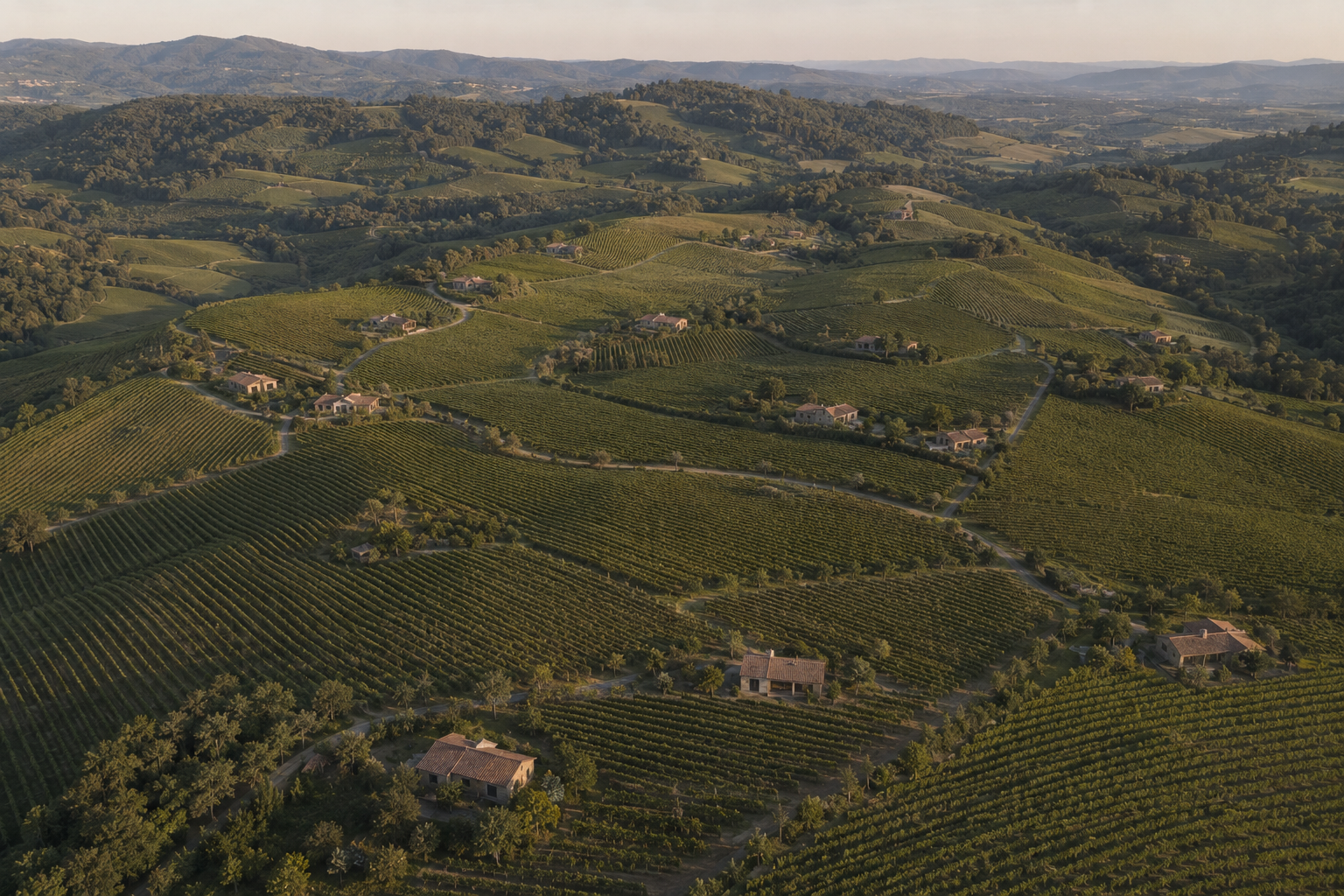
Where life takes root.
ORIGO
Rootedness Protected Through Productive Landscapes
ORIGO is a Governed Hospitality System structured around the Condition of Life of Rootedness.
It integrates hospitality into working rural territories where agriculture remains active, economically productive and primary to the identity and organisation of the place.
Rather than replacing the land, hospitality becomes another expression of it.
The landscape is not scenery.
Production is not staged.
The territory remains alive.
The governing Condition of Life remains constant.
Rootedness.
THE CONDITION OF ROOTEDNESS
Rootedness emerges through a meaningful relationship with territory.
Land.
Seasonality.
Cultivation.
Material culture.
Food.
Climate.
Work.
Time.
Many rural hospitality projects use these elements as visual references while gradually replacing the productive life that created them.
ORIGO follows a different logic.
The productive landscape remains active throughout the life of the project. Hospitality is introduced with sufficient discipline to support the territory without displacing its agricultural identity.
Inhabitants do not simply observe the landscape.
They inhabit a territory that continues to work.
THE ORIGO ENVIRONMENT
An ORIGO environment is a low-density hospitality development integrated into an active productive landscape.
It combines:
→ Distributed private pavilion architecture.
→ Active agricultural production.
→ Territory-based food and beverage.
→ Landscape continuity.
→ Material and climatic intelligence.
→ Long-term territorial coherence.
→ Hospitality integrated without displacing the productive structure of the land.
The architecture remains horizontal and subordinate to the landscape.
Pavilions remain individually dispersed throughout the productive territory and may not be organised into hospitality or residential clusters.
Hospitality does not concentrate itself into a dominant central building.
The productive territory remains visually, economically and operationally primary.
COMPATIBLE PRODUCTIVE LANDSCAPES
ORIGO is not defined by countries or predetermined destinations.
It is defined by productive territorial compatibility.
Compatible landscapes may include:
→ Olive groves.
→ Vineyards.
→ Orchards.
→ Cork landscapes.
→ Agricultural estates.
→ Working forests.
→ Mixed productive rural domains.
Each territory produces a different architectural, agricultural and hospitality expression.
The productive system may change.
The climate may change.
The materials may change.
The governing Condition of Life remains the same.
DESIGNED FOR ROOTEDNESS
ORIGO may be relevant to:
→ Agricultural landowners.
→ Hospitality investors.
→ Developers.
→ Families and long-term territorial owners.
→ Entrepreneurs.
→ Inhabitants seeking a deeper relationship with land and productive life.
→ Owners seeking to combine hospitality value with the continued productive use of their land.
The common objective is not simply to develop rural hospitality.
It is to integrate hospitality into an active productive territory without replacing the agricultural identity that gives the land its value.
WHY ORIGO?
ORIGO integrates hospitality within productive agriculture.
It combines:
→ Hospitality.
→ Active agricultural production.
→ Productive land value.
→ Territory-based food and beverage.
→ Distributed low-density architecture.
→ Carefully integrated branded residences.
→ Long-term territorial and productive coherence.
→ Institutional development discipline.
The hospitality component supports the territory.
It does not replace its productive purpose.
ORIGO BRANDED RESIDENCES
Where permitted by the applicable development configuration, an ORIGO environment may incorporate a carefully limited branded residential component.
ORIGO Branded Residences are not conceived as a separate real estate development placed beside the hospitality environment.
They belong to the same productive landscape and institutional architecture.
They follow the same:
→ Architectural doctrine.
→ Territorial and density discipline.
→ Pavilion logic.
→ Material and landscape principles.
→ Service environment.
→ Long-term territorial coherence requirements.
Residential pavilions may not form separate compounds, introduce a competing architectural identity or interrupt the continuity of the productive landscape.
They must remain individually integrated into the territory according to the same spatial logic as the hospitality pavilions.
Agriculture remains the primary territorial function.
Hospitality remains primary in relation to the residential component.
The productive landscape remains active, economically viable and structurally continuous.
When appropriately integrated, branded residences can support the project’s capital structure, enable long-term ownership within the territory and reinforce productive continuity without transforming ORIGO into a conventional residential development.
Detailed residential eligibility criteria, integration requirements and the applicable maximum participation threshold for each authorised typology are defined within the ORIGO institutional frameworks and made available under NDA.
WHAT MAKES ORIGO DIFFERENT?
Most rural hospitality uses the landscape as scenery.
ORIGO treats the productive landscape as the primary asset.
Many rural hospitality developments treat land primarily as a development platform.
ORIGO treats the productive territory as the foundation of the project.
Many hospitality developments gradually interrupt or replace production.
ORIGO protects its continuity.
Agriculture continues.
The territory continues.
Hospitality emerges from both.
A DIFFERENT FORM OF VALUE
ORIGO creates value through productive continuity.
Agricultural identity.
Territorial coherence.
Working landscapes.
Material authenticity.
Long-term productive continuity.
As productive land becomes increasingly valuable, hospitality environments capable of sustaining active production while supporting inhabitation become increasingly rare.
ORIGO enables hospitality, active agriculture and territorial value to reinforce one another within a coherent institutional framework.
Projects may differ.
Territories may differ.
Agricultural systems may differ.
Architectural expressions may differ.
The governing Condition of Life remains the same.
Rootedness.